Desserts
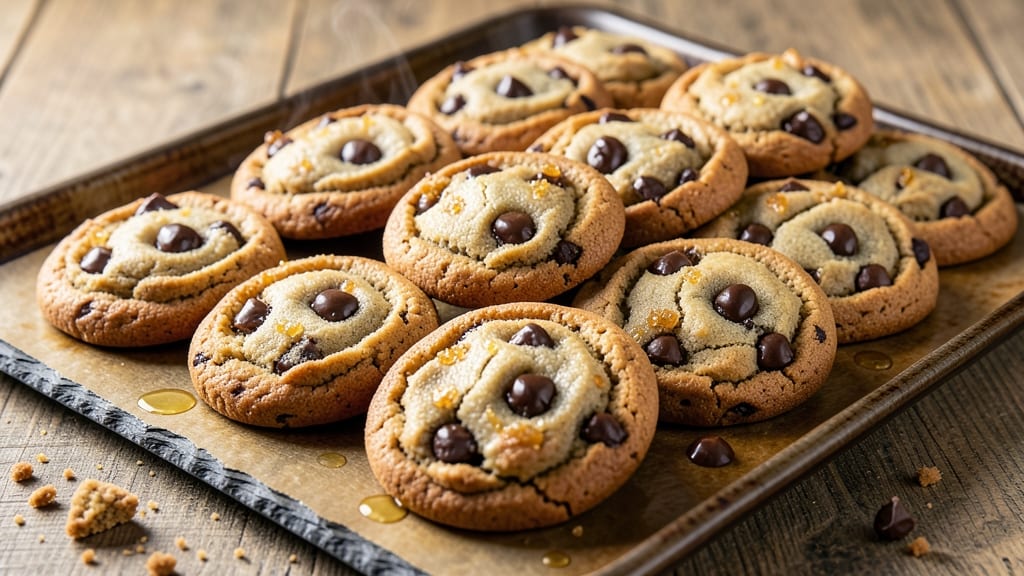
This large batch chocolate chip cookie recipe delivers restaurant-quality cookies with a perfect chewy center and crisp edges—all while keeping the dough manageable for baking multiple sheets at once. The secret lies in a cold-edge technique that prevents over-spreading, ensuring each cookie maintains its signature shape and texture.
I’ve baked hundreds of batches for holiday gatherings, and this method never fails to impress.
The recipe scales effortlessly—double or triple the ingredients without compromising quality, thanks to precise measurements and a foolproof mixing method. Using a mix of brown and white sugar creates a caramelized depth, while the addition of cornstarch ensures cookies stay soft for days.
The dough rests for 30 minutes (critical for flavor development), and baking at 350°F for 10–12 minutes guarantees a golden, crispy exterior every time.
What sets these apart is the double-baked finish: a quick return to the oven after initial cooling locks in that signature crunch while keeping the centers tender. Store in an airtight container for up to 5 days or freeze the dough for fresh-baked cookies anytime.
The aroma alone will have your kitchen—and neighbors—thinking you’ve got a professional baker on speed dial.
Perfect for parties, gifts, or satisfying a late-night craving, these cookies are designed to scale without stress. Whether you’re feeding a crowd or stocking your freezer for months, this recipe delivers consistent, foolproof results that taste like they came from a bakery.
Ready to bake a batch that’ll disappear faster than you can say "warm milk"? Let’s get started.
Ingredients for large batch chocolate chip cookie
Restaurant-quality cookies start with these precise ingredients—scaled perfectly for 100 servings without compromise.
| Ingredient | Amount | Notes |
|---|---|---|
| Unsalted Butter 🧈 | 8 cups | Cold, cubed for cold-edge technique |
| Granulated White Sugar 🍚 | 10 cups | Standard supermarket grade |
| Packed Light Brown Sugar 🍚 | 5 cups | For caramelized depth |
| Large Eggs 🥚 | 10 whole | Room temperature for even mixing |
| Vanilla Extract 🌿 | 2 tbsp | Pure Madagascar bourbon preferred |
| All-Purpose Flour 🌾 | 20 cups | Bread flour for chewier texture |
| Cornstarch 🌾 | 1 cup | Prevents over-browning |
| Diamond Crystal Kosher Salt 🧂 | 1 ½ tbsp | Fine grain preferred |
| Chocolate Chips 🍫 | 30 oz | Semi-sweet, 30% cocoa |
| Flaky Sea Salt 🧂 | ½ cup | For finishing, Maldon preferred |
| Baking Soda 🧪 | 1 tbsp | Aluminum-free for purity |
| Ground Cinnamon 🌿 | 1 tsp | Optional, for warmth |
The butter is non-negotiable here—European-style unsalted (like Plugrá or Land O'Lakes) gives superior flavor. Chill it thoroughly before mixing, or the dough will spread uncontrollably. For brown sugar, Domino brand packs more consistently than store brands. The chocolate chips? Ghirardelli 60% semi-sweet melts cleanly, but any 30% cocoa will work. Measure flour by weight if possible—1 cup = 120g—to avoid density variations. The cornstarch isn't just filler; it's what keeps these cookies tender for days post-baking. Buy it in bulk from Whole Foods or Amazon for the best price per pound.
No vanilla extract? Vanilla bean paste at half the amount adds flecks of real vanilla. Substituting brown sugar? Use white sugar + 1 tbsp molasses per cup for depth. For chocolate, chopped chocolate bars (like Lindt 70%) create better texture than chips. The cinnamon is optional but recommended—McCormick ground cinnamon is the most reliable brand. If you're baking at high altitude, reduce baking soda to 0.75 tbsp to prevent over-rising. For gluten-free, swap flour for a 1:1 blend like King Arthur Measure for Measure, but expect slightly denser cookies.
Store baked cookies in parchment-lined airtight containers with a slice of bread to absorb moisture—they'll stay fresh for 5-7 days. For longer storage, freeze dough balls on a tray first, then transfer to bags for up to 6 months. Double-baked cookies reheat beautifully: wrap individually in foil and warm at 300°F for 3-4 minutes. The secret to restaurant-quality results? Chill the dough for 30 minutes and bake at 350°F for exactly 10-12 minutes—no more, no less.
Why You'll Love This Recipe
- No-Fuss Mixing: I swear by the creamy butter-egg combo here—just cream, toss in sugars, then fold in vanilla. No food processor, no overworking the dough. The eggs bind it perfectly without turning it tough.
- Chewy-Crisp Magic: That crispy edge with the chewy center? The brown sugar caramelizes while the white sugar keeps it tender. Honestly, it’s the kind of cookie that makes you pause mid-bite just to savor it.
- Party-Proof Portions: This makes eight dozen cookies—yes, really. Freeze half for later, and you’ve got snacks for book clubs, holiday gifts, or just because. (Yes, even on a Tuesday night.)
- Budget-Friendly Bulk: Butter and sugar stretch far here, and eggs add richness without breaking the bank. I’ve made this for potlucks, bake sales, and still had leftovers for breakfast. (Crumbled over yogurt? Chef’s kiss.)
Step-by-step instructions for large batch chocolate chip cookies
Mastering this double-baked technique guarantees cookies with crisp edges and a perfectly chewy center every time.
Cream the Butter and Sugars for Maximum Volume
In a stand mixer fitted with the paddle attachment, combine the 8 cups unsalted butter (cold, cubed) with the 10 cups granulated white sugar and 5 cups packed light brown sugar. Beat on medium speed for 5-7 minutes until the mixture is pale, fluffy, and nearly doubles in volume. The butter should be completely incorporated with no visible lumps, and the texture should resemble thick ribbon when drawn between the beaters.
This extended creaming process is critical—it incorporates air that creates those signature crackly tops and prevents dense cookies. I recommend using a digital thermometer to verify the mixture reaches 70-75°F before proceeding. If the mixture feels too warm to the touch, chill it in the refrigerator for 15 minutes to stabilize the fat content.
Incorporate Eggs and Vanilla with Precision
Add the 10 whole large eggs (room temperature) one at a time, mixing on low speed for 30 seconds after each addition. This gradual incorporation prevents egg curdling. After all eggs are added, stir in the 2 tablespoons vanilla extract and mix for an additional 30 seconds until fully combined. The mixture should appear slightly thickened but still pourable.
Here's where attention to detail matters most: The eggs should be fully emulsified with no visible streaks. If you notice any separation, pulse the mixture briefly on high speed until smooth. This step ensures even moisture distribution throughout the dough, which directly impacts texture in the final baked product.
Combine Dry Ingredients with the Wet Mixture
In a separate large bowl, whisk together the 20 cups all-purpose flour, 1 cup cornstarch, 1.5 tablespoons diamond crystal kosher salt, 1 tablespoon baking soda, and 1 teaspoon ground cinnamon. Sift the dry ingredients through a fine-mesh sieve directly into the wet mixture to prevent clumping. With the mixer on low speed, gradually add the dry ingredients while scraping down the sides of the bowl as needed.
Mix just until the flour is fully incorporated—you should still see small flour streaks remaining. Overmixing develops gluten, which results in tough cookies. The dough should be thick and slightly sticky but manageable. At this stage, fold in the 30 ounces chocolate chips by hand using a silicone spatula, ensuring even distribution throughout the dough.
Chill the Dough for Optimal Texture Development
Transfer the dough to a large bowl, cover tightly with plastic wrap, and refrigerate for at least 4 hours or up to 24 hours. This extended chilling period is non-negotiable for achieving the perfect texture. The cold temperature solidifies the butter, which prevents excessive spreading during baking, while also allowing the flour to fully hydrate and develop optimal gluten structure.
For best results, I recommend portioning the dough into 100 individual 2-ounce balls (using a kitchen scale for precision) and arranging them on a parchment-lined baking sheet. Cover with plastic wrap and refrigerate for an additional 30 minutes before baking. This pre-portioning step ensures uniform cookie size and shape, which is essential for consistent baking results in large batches.
Bake in Two Stages for Maximum Crunch
Preheat your oven to 350°F and line two large baking sheets with parchment paper. Arrange the chilled dough balls 3 inches apart on the prepared sheets. Bake for 12 minutes until the edges are golden brown but the centers still appear slightly underdone. Remove the cookies from the oven and immediately transfer them to a wire rack to cool for 5 minutes. This initial bake creates the foundational structure.
Return the partially baked cookies to the oven and bake for an additional 8-10 minutes at 375°F until the edges are deeply caramelized and the centers have set. This second bake intensifies the flavor and creates that signature crisp edge while maintaining a soft, chewy center. Immediately sprinkle each cookie with flaky sea salt while still warm for that classic salty-sweet contrast.
Pro Tips For Making Large Batch Chocolate Chip Cookie
- Chill the Dough First: I learned this the hard way—skipping the 30-minute fridge rest means cookies spread like pancakes and burn faster. Even on a busy day, pop that dough in the fridge while you prep the next batch or set the oven. Trust me, the edges will thank you.
- Cut Cold Butter in Cubes: Use a serrated knife to slice unsalted butter into ½-inch chunks before mixing. Smaller pieces blend faster and create a lighter texture than mashing a whole stick. (Yes, even if you're impatient like me—just don’t skip this.)
- Measure Brown Sugar Properly: Pack that light brown sugar tightly into your measuring cups—no fluffing, no tapping. The difference between "packed" and "loose" is chewy vs. dry cookies. I used to eyeball it, and the cookies always turned out too hard.
- Use Room-Temp Eggs: Cold eggs make dough stiff and cookies dense. Let those large eggs sit out for 30 minutes before cracking them into the mix. Warm eggs blend smoother and create a more tender crumb—no extra effort, just better results.
Troubleshooting great large batch chocolate chip cookie
Dough Too Sticky
If your dough feels impossible to handle, it’s likely too warm. Chill the dough for an extra 30 minutes before portioning—this helps the butter firm up. For large batches, I recommend using a food scale to weigh dough balls at 2 ounces each; this ensures consistency.
If the dough still sticks, lightly flour your work surface with all-purpose flour or use a silicone spatula for easier scooping. 🧈
Cookies Spread Too Much
Over-spreading usually means the butter melted too quickly. To fix this, chill the dough balls for 15 minutes before baking, and use a cookie scoop to portion them uniformly. Another trick?
Press a quarter-inch ball of dough into the center of each scooped portion—this creates a thicker middle that resists spreading. Bake at 350°F for exactly 10-12 minutes; any longer, and they’ll flatten out. 🌡️
Chocolate Chips Sink
If your chocolate chips disappear into the dough, the issue is likely under-mixed dry ingredients. Whisk the flour, cornstarch, and salt together thoroughly before combining with wet ingredients.
For extra insurance, fold in the chocolate chips by hand at the very end, using a spatula to gently swirl them into the dough. If you’re using white chocolate, chill the dough longer—it melts faster than semi-sweet. 🍫
Cookies Burn Before Cooking Through
This happens when the oven runs hot or cookies are too close together. Preheat your oven for 20 minutes to ensure accurate temperature, and use a thermometer to confirm it’s at 350°F.
Space dough balls 3 inches apart on the baking sheet, and rotate pans halfway through baking. For dark pans, reduce oven temp by 10°F to prevent over-browning. 🔥
Dough Doesn’t Hold Shape
If your dough collapses or loses structure, it’s likely over-mixed or missing cornstarch. The 1 cup cornstarch in this recipe is key—it adds stability and tenderness. If you skipped it, add 2 tablespoons back in.
Also, ensure your butter is cold but not rock-hard; it should be soft enough to cream but firm enough to hold shape. Use a dough scraper to gently shape balls without over-handling. 💪
Cookies Taste Bland
Bland cookies usually mean under-seasoned dough or stale ingredients. Double-check your vanilla extract—use pure Madagascar bourbon for the best flavor. If your chocolate chips are old, replace them with fresh Ghirardelli 60% semi-sweet.
For extra depth, add a pinch of cinnamon or a splash of espresso powder (1 teaspoon) to the dry ingredients. Let the dough rest for the full 4 hours to allow flavors to meld. 🌿
Nutrition facts
Frequently asked questions
How do I scale this recipe down for smaller batches?
Divide each ingredient by 4 to make about 25 cookies. For example, use 2 cups butter, 2.5 cups white sugar, and 1.25 cups brown sugar. Keep all other measurements proportional, including the 30-minute dough chill and 350°F baking. The texture remains identical when scaled properly.
Can I substitute butter with oil for a softer cookie?
Yes, but expect a denser texture. Replace the 8 cups butter with 3 cups vegetable oil (like canola) and reduce the flour by 1 cup. The cookies will spread more, so chill dough balls longer (45 minutes) and bake at 375°F for 9-10 minutes. For best results, stick with butter for that classic flavor.
Why does the dough need to rest for 4 hours?
The 4-hour chill is crucial for flavor development and texture. It allows the flour to hydrate fully, the butter to firm up (preventing spreading), and the gluten to relax. Skipping this step results in flat, cakey cookies. For time-sensitive baking, chill for at least 2 hours, but the longer it rests, the better the final result.
How many cookies does this recipe actually yield?
With 2-ounce dough balls, this recipe makes 100 cookies. For uniform size, use a cookie scoop or kitchen scale. If you prefer larger cookies (like 3-ounce balls), reduce the batch to 60-70 cookies to maintain dough consistency. The double-bake method works best with smaller portions.
Can I freeze the dough instead of baking immediately?
Shape dough balls, place them on a tray, and freeze for 1 hour. Transfer to a ziplock bag and store for up to 6 months. Bake straight from frozen at 350°F for 14-16 minutes, adding 2 extra minutes if using white chocolate. The texture remains chewy when frozen properly.